You may inherit from many models!
All models in dwi_ml should be a child class of our MainModelAbstract. See Inherit from MainModelAbstract first.
We have also prepared classes to help with common usages. Your model could easily inherit from them to benefit from what they have to offer. Each of them is a child of our main abstract model (as your own model should be, see
Where to start?
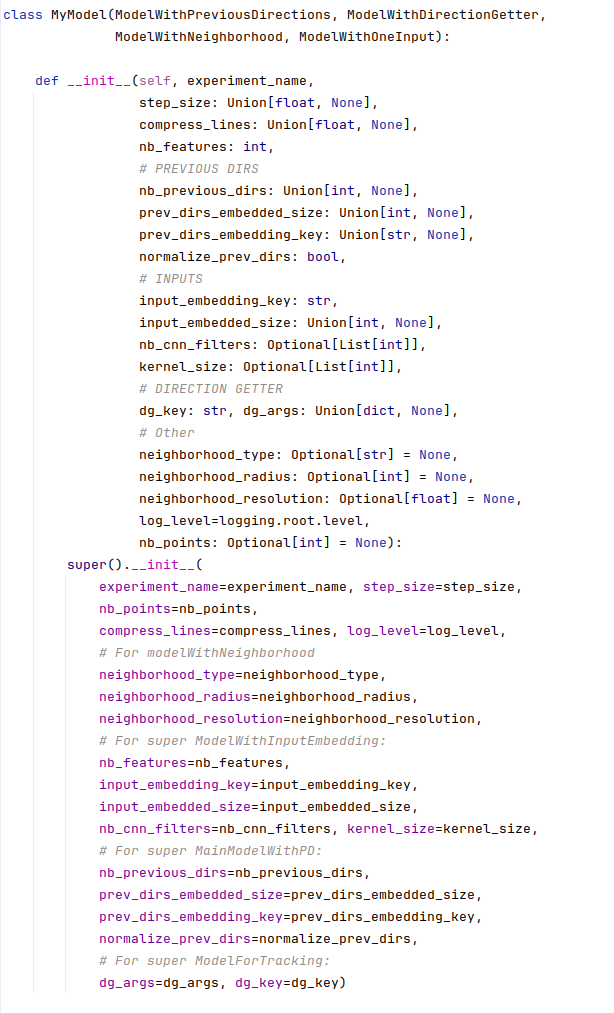
You can read on python multi-parent inheritance, or you can test it yourself! For instance, the model below inherits from all our classes and uses super.__init__(...) to set all parameters at once!
Note
You noticed that we did not explicitely inherit from the MainModelAbstract? It’s because all our models are themselves children of it. So it still is a child of MainModelAbstract.
General models
ModelWithPreviousDirections
In models, streamlines are often used as targets. But you may also need to use them as input. If your model iterates on streamline points and needs a fixed number of inputs at the time, you could use the N previous directions at each position of the streamline (see for instance in Poulin et al. 2017). This model adds parameters for the previous direction, plus embedding choices.
ModelWithDirectionGetter
This is our model intented for tractography models. It defines a layer of what we call the “directionGetter”, which outputs a chosen direction for the next step of tractography propagation, in many possible formats, and knows how to compute the loss function accordingly. See the page The DirectionGetter Layer for more information.
It also contains a
get_tracking_directionsmethod, which should be implemented in your project to use this model for tractography.
Models for usage with DWI inputs
ModelWithNeighborhood
Neighborhood usage: the class adds parameters to deal with a few choices of neighborhood definitions.
ModelWithOneInput
The
MainAbstractModelmakes no assumption of the type of input data required, only that it uses streamlines. In this model here, we added the parameters necessary to add one input volume (ex: the underlying dMRI data). Choose this model, together with theDWIMLTrainerOneInput, and the volume will be interpolated and send to your model’s forward method. Note that if you want to use many images as input, such as the FA, the T1, the dMRI, etc., this can still be considered as “one volume”, if your prepare your hdf5 data accordingly by concatenating the images.It also defines parameters to add an embedding layer.